What the hell is a harness?
The word I use every day, that you have known since childhood, and that almost nobody still pictures — told through the horse tack it came from.
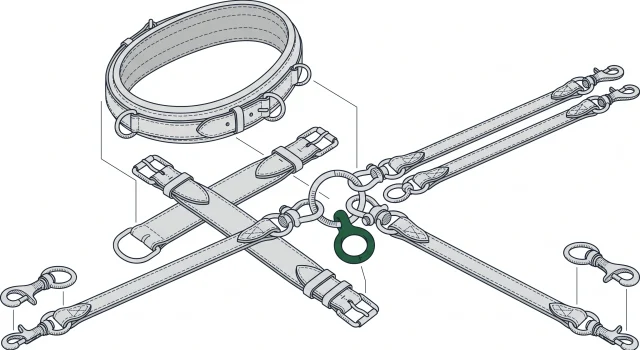
I used the word harness thirty-one times on this site before writing a single line explaining what it means, and the blame for that belongs to a very specific kind of hurry: the hurry of someone who spent months working out a thing that changed how he does his job and wants to hand it over immediately, without stopping to introduce anything. You walk in halfway through a conversation that had been running inside my head for weeks, and it all makes enormous sense — provided you had been in there with me.
I even built a glossary for this site precisely so that no term would be left lying around loose, and the entry still missing was the one word I use more than any other. That is what enthusiasm does to a person: it skips step zero and goes straight to the good part.
You already know this word, which sounds like it should make my job here easier and does the opposite. A term you have to look up stays visible; a term you have owned since you were six goes quiet. You have read "harness" a dozen times this month in something about agents, and I would put money on the fact that not once did a horse turn up.
So let's start where the word starts, which is the horse.
The tack
A harness is the arrangement of collar, girth, traces and buckles you put on the animal before you hitch the cart. Notice what it does not do. It does not make the horse faster, does not add a pound of strength, does not teach it a route it didn't know. A harnessed horse and a horse loose in a field carry exactly the same muscle, and anyone who has watched a horse loose in a field knows precisely what that muscle tends to produce when nobody has agreed on where everyone is going.
What the harness does is turn force into work. It decides where the pull engages, how far the head can turn, what happens when the animal spooks, and above all what doesn't happen — because half of that leather exists to keep the cart from running the horse over on the way down the hill.
Now swap the horse for the model
A language model, on its own, produces text, and that is the whole list. It does not open a file, does not run a command, does not remember yesterday, and above all has no idea whether the thing it just wrote worked or blew up, because nobody told it. Everything we have taken to calling an "agent" is that model plus a layer wrapped around it that handles those four gaps, and that layer is the harness.
It decides, roughly in this order of importance: which tools the model can see, what it is allowed to run without asking, what survives the end of a session, and what fires on its own after every change — that last one being the one people discover last and very nearly always the one that was missing.
Not one of those four lives inside the model, which is why swapping models changes what your agent knows while swapping harnesses changes what it can do with what it knows.
Why this matters more than it looks
The public conversation about agents runs almost entirely on which model to use, which is the part of the equation you have no control over whatsoever and which changes by itself every couple of months, usually on a Tuesday and without warning. The part that belongs to you, that you design, and that decides whether a mistake costs ten minutes or an entire afternoon restoring a backup, is the part on the outside.
An excellent model in a bad harness writes correct code into the wrong directory, deletes the file it shouldn't with exactly the serenity it would have brought to deleting the right one, repeats for the tenth time a call that was refused the previous nine, and closes the session with nothing it learned along the way surviving into the next one. A mediocre model in a good harness gets things wrong less often, and when it does, it gets them wrong in a shape you can undo — which is the only property that genuinely matters once your software acts on the world instead of merely holding opinions about it.
The harness is the part you write
None of this is the prompt, incidentally, and that particular confusion is the most expensive one on offer. The prompt is what you ask for. The harness is what happens to the request after it leaves your mouth: where it travels, what gets checked, what gets refused, what gets written down.
The word reached the AI vocabulary from software engineering, where "test harness" has meant for decades the rig that runs somebody else's code under conditions you control — the same sense as the tack, only without the horse. Whoever picked the term picked well, which around here is not the way to bet.
What the tack teaches
A badly fitted harness hurts the animal, and everybody finds out quickly. A harness left too slack holds nothing, and that one announces itself on the first hill. But there is a third case, the tiresome one, which is the harness pulled tight in the wrong place: the horse walks, the cart rolls, the whole rig appears to be working, and the trouble only surfaces a great many miles later.
Software harnesses have all three faults, in roughly the same proportion.